Monday, June 11, 2012

New finding by Nasa in the Arctic Ocean: Bloom as rich as rain forests found under the sea waters


Scientists have made a biological discovery in Arctic Ocean waters as dramatic and unexpected as finding a rainforest in the middle of a desert. A NASA-sponsored expedition punched through three-foot thick sea ice to find waters richer in microscopic marine plants, essential to all sea life, than any other ocean region on Earth.

The finding reveals a new consequence of the Arctic's warming climate and provides an important clue to understanding the impacts of a changing climate and environment on the Arctic Ocean and its ecology. The discovery was made during a NASA oceanographic expedition in the summers of 2010 and 2011.

The discovery is the result of an oceanographic expedition called ICESCAPE, or Impacts of Climate on EcoSystems and Chemistry of the Arctic Pacific Environment. The finding reveals a new consequence of the Arctic's warming climate and provides an important clue to understanding the impacts of a changing climate and environment on the Arctic Ocean and its ecology. (Credit: NASA's Goddard Space Flight Center)

The expedition called ICESCAPE, or Impacts of Climate on EcoSystems and Chemistry of the Arctic Pacific Environment, explored Arctic waters in the Beaufort and Chukchi seas along Alaska's western and northern coasts onboard a U.S. Coast Guard icebreaker. Using optical technologies, scientists looked at the impacts of environmental variability and change in the Arctic on the ocean biology, ecology and biogeochemistry.
"Part of NASA's mission is pioneering scientific discovery, and this is like finding the Amazon rainforest in the middle of the Mojave Desert," said Paula Bontempi, NASA's ocean biology and biogeochemistry program manager in Washington. "We embarked on ICESCAPE to validate our satellite ocean-observing data in an area of the Earth that is very difficult to get to," Bontempi said. "We wound up making a discovery that hopefully will help researchers and resource managers better understand the Arctic."
The microscopic plants, called phytoplankton, are the base of the marine food chain. Phytoplankton were thought to grow in the Arctic Ocean only after sea ice had retreated for the summer. Scientists now think that the thinning Arctic ice is allowing sunlight to reach the waters under the sea ice, catalyzing the plant blooms where they had never been observed. The findings were published today in the journal Science.
"If someone had asked me before the expedition whether we would see under-ice blooms, I would have told them it was impossible," said Kevin Arrigo of Stanford University in Stanford, Calif., leader of the ICESCAPE mission and lead author of the new study. "This discovery was a complete surprise."
During the July 2011 Chukchi Sea leg of ICESCAPE, the researchers observed blooms beneath the ice that extended from the sea-ice edge to 72 miles into the ice pack. Ocean current data revealed that these blooms developed under the ice and had not drifted there from open water, where phytoplankton concentrations can be high.
The phytoplankton were extremely active, doubling in number more than once a day. Blooms in open waters grow at a much slower rate, doubling in two to three days. These growth rates are among the highest ever measured for polar waters. Researchers estimate that phytoplankton production under the ice in parts of the Arctic could be up to 10 times higher than in the nearby open ocean.
Fast-growing phytoplankton consume large amounts of carbon dioxide. The study concludes that scientists will have to reassess the amount of carbon dioxide entering the Arctic Ocean through biological activity if the under-ice blooms turn out to be common.
"At this point we don't know whether these rich phytoplankton blooms have been happening in the Arctic for a long time and we just haven't observed them before," Arrigo said. "These blooms could become more widespread in the future, however, if the Arctic sea ice cover continues to thin."
Previously, researchers thought the Arctic Ocean sea ice blocked most sunlight needed for phytoplankton growth. But in recent decades younger and thinner ice has replaced much of the Arctic's older and thicker ice. This young ice is almost flat and the ponds that form when snow cover melts in the summer spread much wider than those on rugged older ice.

These extensive but shallow melt ponds act as windows to the ocean, letting large amounts of sunlight pass through the ice to reach the water below, said Donald Perovich, a geophysicist with the U.S. Army Cold Regions and Engineering Laboratory in Hanover, N.H., who studied the optical properties of the ice during the ICESCAPE expedition.

"When we looked under the ice, it was like a photographic negative. Beneath the bare-ice areas that reflect a lot of sunlight, it was dark. Under the melt ponds, it was very bright," Perovich said. He is currently visiting professor at Dartmouth College's Thayer School of Engineering.

The discovery of these previously unknown under-ice blooms also has implications for the broader Arctic ecosystem, including migratory species such as whales and birds. Phytoplankton are eaten by small ocean animals, which are eaten by larger fish and ocean animals. A change in the timeline of the blooms can cause disruptions for larger animals that feed either on phytoplankton or on the creatures that eat these microorganisms. "It could make it harder and harder for migratory species to time their life cycles to be in the Arctic when the bloom is at its peak," Arrigo said. "If their food supply is coming earlier, they might be missing the boat."

Bontempi believes the discovery also may have major implications for the global carbon cycle and the ocean's energy balance. "The discovery certainly indicates we need to revise our understanding of the ecology of the Arctic and the region's role in the Earth system," Bontempi said.
Previously, researchers thought the Arctic Ocean sea ice blocked most sunlight needed for phytoplankton growth. But in recent decades younger and thinner ice has replaced much of the Arctic's older and thicker ice. This young ice is almost flat and the ponds that form when snow cover melts in the summer spread much wider than those on rugged older ice.
These extensive but shallow melt ponds act as windows to the ocean, letting large amounts of sunlight pass through the ice to reach the water below, said Donald Perovich, a geophysicist with the U.S. Army Cold Regions and Engineering Laboratory in Hanover, N.H., who studied the optical properties of the ice during the ICESCAPE expedition.

"When we looked under the ice, it was like a photographic negative. Beneath the bare-ice areas that reflect a lot of sunlight, it was dark. Under the melt ponds, it was very bright," Perovich said. He is currently visiting professor at Dartmouth College's Thayer School of Engineering.

The discovery of these previously unknown under-ice blooms also has implications for the broader Arctic ecosystem, including migratory species such as whales and birds. Phytoplankton are eaten by small ocean animals, which are eaten by larger fish and ocean animals. A change in the timeline of the blooms can cause disruptions for larger animals that feed either on phytoplankton or on the creatures that eat these microorganisms. "It could make it harder and harder for migratory species to time their life cycles to be in the Arctic when the bloom is at its peak," Arrigo said. "If their food supply is coming earlier, they might be missing the boat."

Bontempi believes the discovery also may have major implications for the global carbon cycle and the ocean's energy balance. "The discovery certainly indicates we need to revise our understanding of the ecology of the Arctic and the region's role in the Earth system," Bontempi said.
These extensive but shallow melt ponds act as windows to the ocean, letting large amounts of sunlight pass through the ice to reach the water below, said Donald Perovich, a geophysicist with the U.S. Army Cold Regions and Engineering Laboratory in Hanover, N.H., who studied the optical properties of the ice during the ICESCAPE expedition.
"When we looked under the ice, it was like a photographic negative. Beneath the bare-ice areas that reflect a lot of sunlight, it was dark. Under the melt ponds, it was very bright," Perovich said. He is currently visiting professor at Dartmouth College's Thayer School of Engineering.

The discovery of these previously unknown under-ice blooms also has implications for the broader Arctic ecosystem, including migratory species such as whales and birds. Phytoplankton are eaten by small ocean animals, which are eaten by larger fish and ocean animals. A change in the timeline of the blooms can cause disruptions for larger animals that feed either on phytoplankton or on the creatures that eat these microorganisms. "It could make it harder and harder for migratory species to time their life cycles to be in the Arctic when the bloom is at its peak," Arrigo said. "If their food supply is coming earlier, they might be missing the boat."

Bontempi believes the discovery also may have major implications for the global carbon cycle and the ocean's energy balance. "The discovery certainly indicates we need to revise our understanding of the ecology of the Arctic and the region's role in the Earth system," Bontempi said.
"When we looked under the ice, it was like a photographic negative. Beneath the bare-ice areas that reflect a lot of sunlight, it was dark. Under the melt ponds, it was very bright," Perovich said. He is currently visiting professor at Dartmouth College's Thayer School of Engineering.
The discovery of these previously unknown under-ice blooms also has implications for the broader Arctic ecosystem, including migratory species such as whales and birds. Phytoplankton are eaten by small ocean animals, which are eaten by larger fish and ocean animals. A change in the timeline of the blooms can cause disruptions for larger animals that feed either on phytoplankton or on the creatures that eat these microorganisms. "It could make it harder and harder for migratory species to time their life cycles to be in the Arctic when the bloom is at its peak," Arrigo said. "If their food supply is coming earlier, they might be missing the boat."

Bontempi believes the discovery also may have major implications for the global carbon cycle and the ocean's energy balance. "The discovery certainly indicates we need to revise our understanding of the ecology of the Arctic and the region's role in the Earth system," Bontempi said.
The discovery of these previously unknown under-ice blooms also has implications for the broader Arctic ecosystem, including migratory species such as whales and birds. Phytoplankton are eaten by small ocean animals, which are eaten by larger fish and ocean animals. A change in the timeline of the blooms can cause disruptions for larger animals that feed either on phytoplankton or on the creatures that eat these microorganisms. "It could make it harder and harder for migratory species to time their life cycles to be in the Arctic when the bloom is at its peak," Arrigo said. "If their food supply is coming earlier, they might be missing the boat."
Bontempi believes the discovery also may have major implications for the global carbon cycle and the ocean's energy balance. "The discovery certainly indicates we need to revise our understanding of the ecology of the Arctic and the region's role in the Earth system," Bontempi said.

ICESCAPE, or Impacts of Climate on EcoSystems and Chemistry of the Arctic Pacific Environment, is a shipborne NASA mission to explore the impacts of climate change in the Arctic Ocean. During summer of 2011, the ICESCAPE scientists discovered a large bloom of ocean plant life growing under sea ice. 

Thursday, June 7, 2012

Carbonmonoxide poisoning is dangerous: Tips to prevent CO poisoning deaths


Prevent CO Poisoning

The most common symptoms of CO poisoning  are headache,

dizziness, weakness, nausea, vomiting, chest pain, 

and confusion. People who are sleeping or who have been

drinking alcohol can die from CO poisoning before ever

having symptoms


Graphic: Carbon Monpxode (CO) Poisoning. Can't be seen. Can't be smelled. Can't be heard. CAN be stopped.Every year, nearly 450 people die in the U. S. from accidental CO poisoning. Change the batteries in your CO detector every six months. If you don't have a battery-powered or battery back-up CO detector, buy one soon.
CO is found in fumes produced by portable generators, stoves, lanterns, and gas ranges, or by burning charcoal and wood. CO from these sources can build up in enclosed or partially enclosed spaces. People and animals in these spaces can be poisoned and can die from breathing CO.

How to Recognize CO Poisoning

The most common symptoms of CO poisoning are headache, dizziness, weakness, nausea, vomiting, chest pain, and confusion. People who are sleeping or who have been drinking alcohol can die from CO poisoning before ever having symptoms.
  • Never use a gas range or oven to heat a home.
  • Never leave the motor running in a vehicle parked in an enclosed or partially enclosed space, such as a garage.
  • Graphic: Carbon Monoxide (CO) can be deadly. Protect you family. Install a CO gas detector.Never run a generator, pressure washer, or any gasoline-powered engine inside a basement, garage, or other enclosed structure, even if the doors or windows are open, unless the equipment is professionally installed and vented. Keep vents and flues free of debris, especially if winds are high. Flying debris can block ventilation lines.
  • Never run a motor vehicle, generator, pressure washer, or any gasoline-powered engine less than 20 feet from an open window, door, or vent where exhaust can vent into an enclosed area.
  • Never use a charcoal grill, hibachi, lantern, or portable camping stove inside a home, tent, or camper.
  • If conditions are too hot or too cold, seek shelter with friends or at a community shelter.
  • If CO poisoning is suspected, consult a health care professional right away.
CO poisoning is entirely preventable. You can protect yourself and your family by acting wisely in case of a power outage and learning the symptoms of CO poisoning.
For more information, please visit www.cdc.gov/co

Wednesday, June 6, 2012

The transit of Venus on June 6, 2012


The transit of Venus on june 6, 2012, The sun in all its splendour and the black beauty spot is the venus

The transit of Venus and the search for other worlds


mural of the first recorded transit of VenusThe first recorded transit of Venus:William Crabtree (1610–1644) was an astronomer, mathematician, and merchant from what is now Greater Manchester, England. He was one of only two people to observe and record the first predicted transit of Venus in 1639.
Credit: Ford Madox Brown, mural at Manchester Town Hall.

graph of the light measured from a star as a planet transits itLight curve of a planet transiting its star:Transit data are rich with information. By measuring the depth of the dip in brightness and knowing the size of the star, scientists can determine the size or radius of the planet. The orbital period of the planet can be determined by measuring the elapsed time between transits. Once the orbital period is known, Kepler's Third Law of Planetary Motion can be applied to determine the average distance of the planet from its stars.
Credit: NASA Ames
It's the final opportunity of the century to witness the rare astronomical reunion of the sun, Venus and Earth. On Tuesday, June 5 or 6, 2012 depending on your location, Venus will make its presence in the solar system visible from Earth’s day side. Viewers will see Venus as a small dot slowly drifting across the golden disk of the sun.

Transits of Venus are very rare, separated by more than a hundred years. There have been 53 transits since 2000 B.C. but only six have been witnessed since the invention of the telescope in 1608. These rare events occur in pairs, with the first transit occurring June 8, 2004. The next opportunity won't be until Dec. 10-11, 2117.

Jeremiah Horrocks and William Crabtree, two young astronomers from England, recorded the first observation of a transit in 1639. In 1769, survey crews, including Captain James Cook, gathered transit data from various locations around the world that were later used to calculate the distance between Earth and the sun, thereby establishing the solar system's scale.

"Throughout history, astronomers have creatively used nature's coincidences as opportunities to learn something new about the universe," said Natalie Batalha, Kepler mission scientist at NASA Ames Research Center, Moffett Field, Calif. "Today is no different. As Venus crosses the disk of the sun, her shadow sweeps across the face of Earth in the same way that the shadows cast by distant exoplanets sweep across the face of the Kepler photometer."

Today, transit events are used to detect planets beyond the solar system. NASA's Kepler space telescope continuously measures changes in brightness of more than 150,000 stars to detect when a planet passes or transits in front of a star. Kepler does not directly image distant planets, as they are too far away.

Different size planets block different amounts of starlight. Kepler's exquisitely precise photometer, or light sensor, is designed to detect fractional changes in brightness. For an Earth-size planet transiting a sun-like star, the change in brightness is only 84 parts per million. That is less than 1/100th of one percent, or the equivalent of the amount of light blocked if a gnat crawled across a car’s headlight viewed from several miles away. 

Transit data are rich with information. By measuring the depth of the dip in brightness and knowing the size of the star, scientists can determine the size or radius of the planet. The orbital period of the planet can be determined by measuring the elapsed time between transits. Once the orbital period is known, Kepler's Third Law of Planetary Motion can be applied to determine the average distance of the planet from its stars.

Using the transit method, the Kepler mission has identified 61 planets and more than 2,300 planet candidates during the spacecraft's first 16 months of observation from May 2009 to September 2010.

Wresting in the outer space: Nasa says giant black hold kicked out of home galaxy

Astronomers have found strong evidence that a massive
black hole is being ejected from its host galaxy at a speed of
several million miles per hour. New observations from NASA's Chandra
X-ray Observatory suggest that the black hole collided and merged
with another black hole and received a powerful recoil kick from
gravitational wave radiation.

"It's hard to believe that a supermassive black hole weighing millions
of times the mass of the sun could be moved at all, let alone kicked
out of a galaxy at enormous speed," said Francesca Civano of the
Harvard-Smithsonian Center for Astrophysics (CfA), who led the new
study. "But these new data support the idea that gravitational waves
-- ripples in the fabric of space first predicted by Albert Einstein
but never detected directly -- can exert an extremely powerful
force."

Although the ejection of a supermassive black hole from a galaxy by
recoil because more gravitational waves are being emitted in one
direction than another is likely to be rare, it nevertheless could
mean that there are many giant black holes roaming undetected out in
the vast spaces between galaxies.

"These black holes would be invisible to us," said co-author Laura
Blecha, also of CfA, "because they have consumed all of the gas
surrounding them after being thrown out of their home galaxy."

Civano and her group have been studying a system known as CID-42,
located in the middle of a galaxy about 4 billion light years away.
They had previously spotted two distinct, compact sources of optical
light in CID-42, using NASA's Hubble Space Telescope.

More optical data from the ground-based Magellan and Very Large
Telescopes in Chile supplied a spectrum (that is, the distribution of
optical light with energy) that suggested the two sources in CID-42
are moving apart at a speed of at least 3 million miles per hour.

Previous Chandra observations detected a bright X-ray source likely
caused by super-heated material around one or more supermassive black
holes. However, they could not distinguish whether the X-rays came
from one or both of the optical sources because Chandra was not
pointed directly at CID-42, giving an X-ray source that was less
sharp than usual.

"The previous data told us that there was something special going on,
but we couldn't tell if there were two black holes or just one," said
another co-author Martin Elvis, also of CfA. "We needed new X-ray
data to separate the sources."

When Chandra's sharp High Resolution Camera was pointed directly at
CID-42, the resulting data showed that X-rays were coming only from
one of the sources. The team thinks that when two galaxies collided,
the supermassive black holes in the center of each galaxy also
collided. The two black holes then merged to form a single black hole
that recoiled from gravitational waves produced by the collision,
which gave the newly merged black hole a sufficiently large kick for
it to eventually escape from the galaxy.

The other optical source is thought to be the bright star cluster that
was left behind. This picture is consistent with recent computer
simulations of merging black holes, which show that merged black
holes can receive powerful kicks from the emission of gravitational
waves.

There are two other possible explanations for what is happening in
CID-42. One would involve an encounter between three supermassive
black holes, resulting in the lightest one being ejected. Another
idea is that CID-42 contains two supermassive black holes spiraling
toward one another, rather than one moving quickly away.

Both of these alternate explanations would require at least one of the
supermassive black holes to be very obscured, since only one bright
X-ray source is observed. Thus the Chandra data support the idea of a
black hole recoiling because of gravitational waves.

These results will appear in the June 10 issue of The Astrophysical
Journal.

NASA's Marshall Space Flight Center in Huntsville, Ala., manages the
Chandra Program for the agency's Science Mission Directorate in
Washington. The Smithsonian Astrophysical Observatory in Cambridge,
Mass., controls Chandra's science and flight operations.

Fiery arc of the second planet: When Venus, the planet of love, spits fire


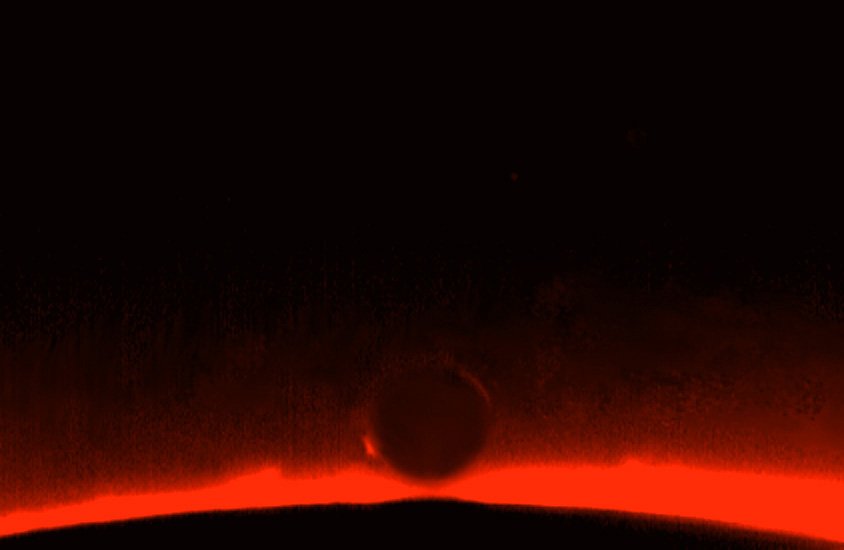
When Venus transits the sun on June 5th and 6th, an armada of spacecraft and ground-based telescopes will be on the lookout for something elusive and, until recently, unexpected: The Arc of Venus.
"I was flabbergasted when I first saw it during the 2004 transit," recalls astronomy professor Jay Pasachoff of Williams College. "A bright, glowing rim appeared around the edge of Venus soon after it began to move into the sun."
For a brief instant, the planet had turned into a "ring of fire."
Arc of Venus (arc rising, 558px)
The Arc of Venus observed during the planet's 2004 transit by amateur astronomer André Rondi using a 10-cm refractor near Toulouse, France.
Researchers now understand what happened. Backlit by the sun, Venus's atmosphere refracted sunlight passing through layers of air above the planet's cloudtops, creating an arc of light that was visible in backyard telescopes and spacecraft alike.
It turns out, researchers can learn a lot about Venus by observing the arc. Indeed, it touches on some of the deepest mysteries of the second planet.
Arc of Venus (ring of fire, 200px)
The arc of Venus photographed in 2004 by Riccardo Robitschek and Giovanni Maria Caglieris of Milan, Italy. 
"We do not understand why our sister planet's atmosphere evolved to be so different than Earth's," explains planetary scientist Thomas Widemann of the Observatoire de Paris.
Earth and Venus are similar distances from the sun, are made of the same basic materials, and are almost perfect twins in terms of size. Yet the two planets are wrapped in stunningly dissimilar blankets of air. Venus's atmosphere is almost 100 times more massive than Earth's and consists mainly of CO2, a greenhouse gas that raises the surface temperature to almost 900°F. Clouds of sulfuric acid tower 14 miles high and whip around the planet as fast as 220 mph. A human being transported to this hellish environment would be crushed, suffocate, desiccate, and possibly ignite.
For the most part, planetary scientists have no idea how Venus turned out this way.
"Our models and tools cannot fully explain Venus, which means we lack the tools for understanding our own planet," points out Widemann. "Caring about Venus is caring about ourselves."
One of the biggest mysteries of Venus is super-rotation. The whole atmosphere circles the planet in just four Earth days, much faster than the planet's spin period of 243 days. "The dynamics of super-rotation are still a puzzle despite a wealth of data from landmark missions such as NASA's Pioneer Venus, Russia's Venera and VEGA missions, NASA's Magellan and more recently ESA's Venus Express."
Arc of Venus (TRACE, 200px)
The arc of Venus as seen by NASA's TRACE spacecraft in 2004. Credit: J. Pasachoff, G. Schneider, L. Golub. 
This is where the Arc of Venus comes in. The brightness of the arc reveals the temperature and density structure of Venus's middle atmosphere, or "mesosphere," where the sunlight is refracted. According to some models, the mesosphere is key to the physics of super-rotation. By analyzing the lightcurve of the arc, researchers can figure out the temperature and density of this critical layer from pole to pole.
When the arc appeared in 2004, the apparition took astronomers by surprise; as a result, their observations were not optimized to capture and analyze the fast-changing ring of light.
This time, however, they are ready. Together, Pasachoff and Widemann have organized a worldwide effort to monitor the phenomenon on June 5th, 2012. "We're going to observe the arc using 9 coronagraphs spaced around the world," says Pasachoff. "Observing sites include Haleakala, Big Bear, and Sacramento Peak. Japan's Hinode spacecraft and NASA's Solar Dynamics Observatory will also be gathering data."
Pasachoff has some advice for amateur astronomers who wish to observe the arc. "The best times to look are ingress and egress--that is, when the disk of Venus is entering and exiting the sun. Ingress is between 22:09 and 22:27 UT on June 5th; egress occurs between 04:32 and 04:50 UT. Be sure your telescope is safely filtered. Both white light and H-alpha filters might possibly show the arc."